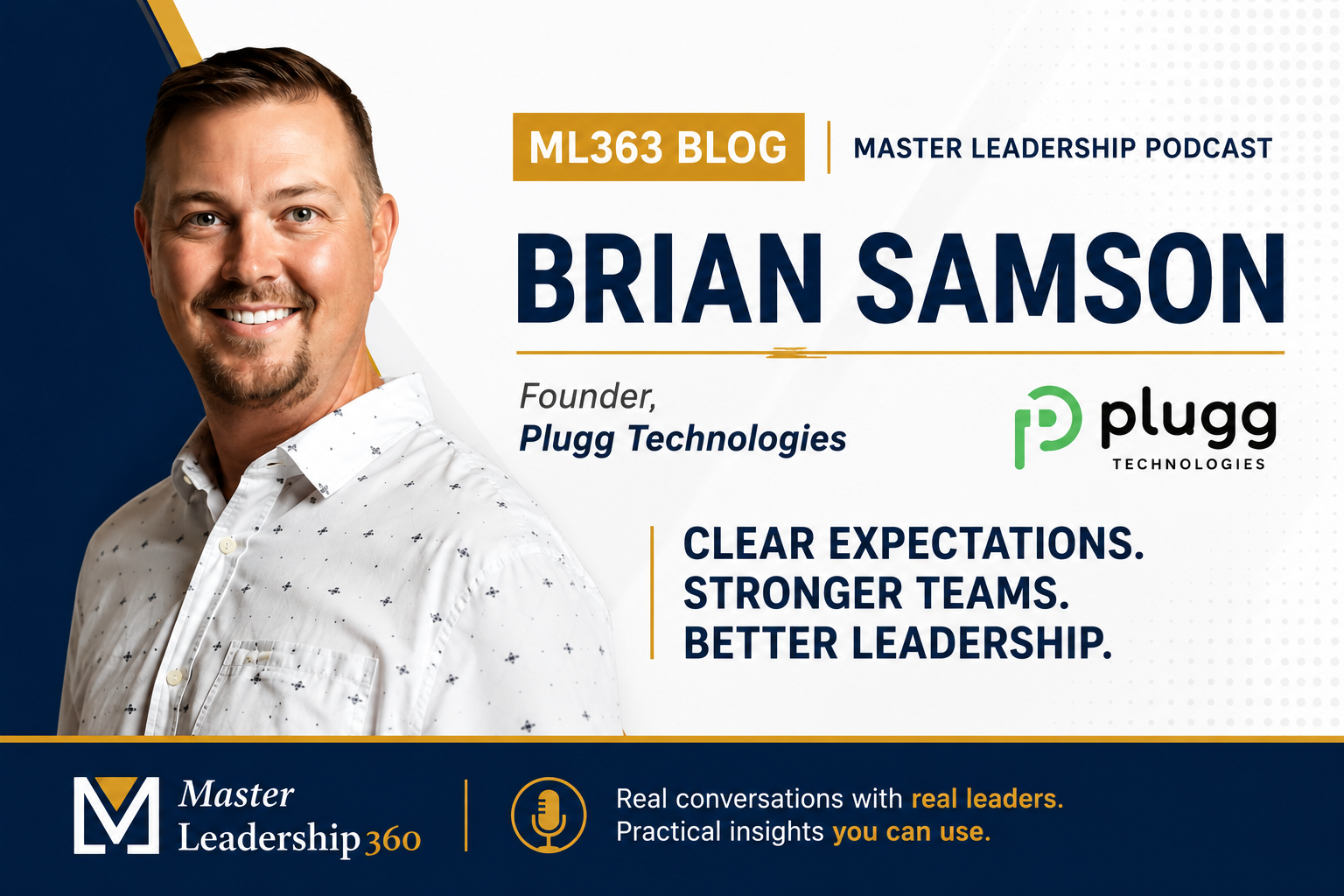
Clear Expectations and Catching People Doing Things Right
Originally featured on the Master Leadership Podcast (ML363) with Lily Sanabria | Guest: Brian Samson, Founder of Plugg Technologies
Most leadership advice tells you to work harder, communicate more, or develop a stronger vision. On a recent episode of the Master Leadership Podcast, host Lily Sanabria asked Brian Samson a deceptively simple question about his leadership journey, and his answer pointed somewhere else entirely. Samson’s career suggests the real answer is simpler and more counterintuitive: set clear expectations from day one, and spend your energy catching people doing things right instead of catching them doing things wrong. That insight, which Lily drew out through careful questioning, traces back to Samson’s teenage years in a Chicago-area fast food restaurant and has shaped every company he has built since. It is the kind of foundational principle that sounds obvious until you realize almost nobody actually practices it.
Lily Sanabria, host of the Master Leadership Podcast, drew this thread out across a wide-ranging conversation that covered Samson’s path from a Midwest restaurant worker to the founder of a nearshore staffing company operating across Latin America. Lily Sanabria’s questions pushed Samson to connect his earliest work experiences to the leadership philosophy he uses today, and the result is a rare episode that manages to be practical, personal, and genuinely useful for anyone who manages other people.
Samson brings more than theory to the table. As founder of Plugg Technologies, he has spent 11 years in nearshore staffing, made 500+ placements, built three companies to $4M ARR each, and once moved to Buenos Aires with two suitcases to build a company to 80 engineers before exiting. He now runs five companies from Hawaii, and by his own account does so with little visible stress. The conversation with Lily Sanabria reveals exactly how.
What a Burger Joint Taught Brian Samson About Leadership
Samson’s first real job was at Fuddruckers, a burger chain that was common in the 1990s. The setup was unusual: customers ordered at a counter, filled their own drinks, picked up their food when called, and then dressed their burgers at a condiment bar. Samson’s role was to circulate through the dining room offering refills and desserts. Nobody explained this to customers, and Samson himself was unclear on what success looked like.
“I was confused on the value that I was doing,” he told Lily Sanabria. “The customers were confused.” It was a small job at a casual restaurant, but it contained a lesson he has carried for decades: if the person doing a job does not have a clear picture of what success looks like, neither the employee nor the customer benefits.
His second restaurant job, at Portillo’s in the Chicago area, reinforced the point from a different angle. Portillo’s ran a high-volume drive-thru with 40 cars waiting at any given time. Nearly every manager there used the same approach: patrol the floor looking for mistakes and call them out loudly. The staff was tense. Then there was one manager who did the opposite. He moved through the restaurant looking specifically for things employees were doing right and acknowledged them publicly. Everyone relaxed when he appeared. Performance improved.
Years later, Samson read the management book Whale Done, which is built entirely around this principle. He realized that the manager at Portillo’s had been practicing it intuitively, without ever having read the book. “Catching people doing something right” and giving people clarity on what success looks like became, in Samson’s words, foundational to every company he has founded since.
Why Latin America Makes More Sense Than Offshore for U.S. Teams
When Samson describes the case for nearshore staffing, he makes two distinct arguments depending on the economic environment, and the combination is more persuasive than either one alone.
In a tight labor market, as the U.S. experienced in 2021 and 2022, the argument is about access. Wages were climbing, qualified candidates were scarce, and companies that had never considered Latin American talent were suddenly unable to fill roles domestically. Latin America has software engineers, marketing professionals, call center staff, operations leaders, and more. The talent is there.
In a tighter capital environment, the argument shifts to cost. Samson is direct about the numbers: labor in Latin America generally runs 40 to 60 percent less than equivalent roles in the United States. If a company has six months of runway, nearshore hiring can stretch that to a year without reducing headcount or capability.
What holds both arguments together is a structural advantage that offshore options in Asia do not offer: time zones. When a team is split between the U.S. and India or the Philippines, someone is always compromising. Either the American team is taking early morning calls, or the offshore team is working late into the night. Latin America eliminates that problem entirely. Every country in the region runs on schedules that overlap cleanly with U.S. business hours. For Samson, this is not a minor convenience. It is what makes collaboration actually work.
Cultural alignment is the third piece. Latin American professionals who work with U.S. companies tend to share communication norms, professional expectations, and work styles in ways that reduce friction over time. Samson’s team at Plugg Technologies does about 100 placements per year and runs what he calls “nearshore curious conversations” for companies that want to understand specific countries, talent pockets, hardware logistics, and currency considerations before committing.
Running Five Companies Without the Stress: How Perspective Actually Works
Lily noticed something during the conversation that she named directly: “I typically can feel energies even on Zoom. I don’t feel any stress from you.” She asked Samson to explain how someone running five companies, living in Hawaii, and raising two young children manages to operate that way.
His answer had two parts. The first is structural. Samson has deliberately built his business holdings so that no single failure cascades across all of them. He owns a nearshore staffing company, a recruiting business, a cleaning company, a locksmith operation, and an AI implementation company. The businesses operate in completely different industries with different operators running each one. A bad month in the locksmith business has no connection to the performance of his Latin America staffing work. COVID taught him this directly: when the pandemic wiped out his revenue in 2020, he was the sole income for his family in one of the most expensive states in the country. He rebuilt with dispersion as a design principle.
The second part is psychological. Samson described a moment in college when he went to his chapter advisor in a panic about losing a few members from a student organization. The advisor told him to slow down: cancer is serious, this is not. Years later, Samson and his wife became licensed foster parents and eventually adopted a child who had experienced severe trauma. That experience reframed what a real crisis looks like. “What you’re dealing with really isn’t that big of a deal,” he said, reflecting on how perspective accumulates over time. “You’ve gone through the fire a few times and just having the right perspective that it’s really not that bad.”
On Fear, Vulnerability, and What Leaders Need to Say Out Loud
Lily Sanabria spent time in the episode discussing a book she is writing called Master Fear, which examines how fear shapes leadership. She asked Samson for his perspective on how leaders should handle uncertainty, and his answer was both practical and honest.
Samson’s view is that it is completely acceptable to be afraid, but that the job of an executive is to verbalize it rather than suppress it. When a CEO says in a team meeting, “I’m not sure what I’m going to be doing in two years” or “I don’t know how AI is going to change my role,” they are not showing weakness. They are setting the cultural standard that uncertainty is normal and that talking about it is allowed.
As Lily observed: “Not a lot of people have that perspective where the top level leader, the executive leader needs to show that vulnerability. And why is that important? It sets the culture. It creates the signals and the cues for everybody else because, whether we like it or not, we emulate the leadership.” Samson agreed, and extended the point: the first time someone raises a concern, even if you disagree with it, the right response is to make them feel genuinely heard. You do not have to implement their suggestion. You just have to acknowledge it in a way that signals you value their input. After that, people keep bringing you feedback.
What AI Is Actually Doing for Samson Right Now
When Lily Sanabria asked what Samson is focused on learning, his answer was AI, and he described his approach with unusual specificity. He has set himself a small budget for experimentation and given himself explicit permission to buy tools that turn out to be useless. His reasoning: if half the tools fail but a few turn out to be genuinely valuable, the budget is well spent.
One tool he mentioned by name is Delphi, which allows users to create what Samson described as a clone of themselves. He has fed it all of his podcast episodes, and the resulting voice model answers questions in his voice and in the style of responses he would typically give. He acknowledged it is unsettling, but sees clear practical applications: training sales teams, building customer service tools, answering routine inquiries at scale.
His broader view on AI is optimistic. He expects it to accelerate entrepreneurship by lowering the cost of starting companies and giving individuals more leverage. For a person whose entire career has been built on finding leverage, that prospect is genuinely exciting rather than threatening.
The Leadership Lesson From Parenting No One Talks About
One of the more unexpected exchanges in the episode came when a question was posed from a prior guest: what have you had to unlearn? Samson’s answer was personal and landed well precisely because it was not about business.
Before his son was born, he had absorbed the cultural message that parenthood is transformative and joyful. A close friend pulled him aside and said something different: it is going to be really hard for a while. You will be stressed and sleepless. That is normal, and almost nobody says it. Samson found that reframe valuable, and drew the parallel to leadership explicitly. The best things can also be the hardest. Mental preparation for difficulty is not pessimism; it is honesty.
He also made the case for having people around you who tell you the truth. An inner circle that flatters you is not an inner circle. People who will say the uncomfortable thing before you make a mistake are the ones worth keeping close. That principle, he suggested, applies as much to running a company as it does to raising children.
How to Get Started With Nearshore Hiring
- Define the role with unusual specificity before you start recruiting. One of Samson’s core insights is that unclear expectations are the root cause of most performance problems. Before engaging a staffing partner, write down what success looks like at 30, 90, and 180 days. This will save time and produce better matches.
- Have a “nearshore curious conversation” first. Plugg Technologies runs educational sessions specifically for companies that are new to Latin American hiring. These cover individual countries, talent availability by role, hardware and equipment logistics, currency considerations, and common pitfalls. It is a low-commitment way to understand the landscape before making any hire.
- Run the time zone math. The most underrated advantage of nearshore staffing is overlap. Map your existing team’s working hours against the countries you are considering. If real-time collaboration is part of your workflow, time zone alignment is not optional. Latin America gives you that alignment by default.
- Build in the management culture before the hire arrives. Samson’s restaurant-era insight still applies: decide in advance how your managers are going to recognize good work. If the only time someone hears from their manager is when something is wrong, you are replicating the Portillo’s model that did not work. Catching people doing things right is a system, not an instinct.
The throughline of this episode is that good leadership is less about having the right strategy and more about building the right environment: one where people know what success looks like, feel safe to raise concerns, and hear about it when they do something well. Samson built that understanding as a teenager in a fast food restaurant and has applied it across every company he has founded since. The conversation with Lily Sanabria is worth your time not because it covers new ground, but because it covers important ground clearly.
�� Listen to the full episode: Brian Samson on Master Leadership with Lily Sanabria
�� Learn more about nearshore hiring: plugg.tech
�� The Nearshore Cafe Podcast: open.spotify.com/show/6KYcgpmN77fJm6B25469B8
Frequently Asked Questions
What is nearshore staffing, and how is it different from offshoring?
Nearshore staffing means hiring talent from countries in a similar time zone to your own, rather than from regions with large time differences. For U.S. companies, this typically means Latin America. Unlike offshoring to Asia, nearshore arrangements allow U.S. teams and their remote colleagues to work overlapping hours without anyone having to compromise their schedule. Brian Samson and Plugg Technologies specialize in this model, connecting senior Latin American tech professionals with U.S. companies.
Why do U.S. companies prefer Latin American talent over talent from India or the Philippines?
The primary advantage is time zone alignment. Latin American countries operate on schedules that overlap directly with U.S. business hours, which makes real-time collaboration straightforward. Offshore teams in Asia require someone to work outside normal hours, which leads to communication delays and operational friction. Brian Samson of Plugg Technologies also points to strong cultural alignment between Latin American professionals and U.S. work norms as a factor that reduces friction over time.
What types of roles can be filled through nearshore staffing?
The range is broader than most hiring managers expect. Plugg Technologies places software engineers, QA specialists, data professionals, marketing staff, call center representatives, operations managers, and leadership roles. The Latin American talent market has grown significantly and now covers most functions a U.S. company might need. Brian Samson frequently points out that if a company cannot find a qualified candidate in the U.S., there is a strong chance that person exists in Latin America.
How much can a U.S. company save by hiring through a nearshore staffing firm?
According to Brian Samson, labor costs in Latin America typically run 40 to 60 percent below equivalent roles in the United States. The exact savings depend on the country, the role level, and current exchange rates. For companies operating with tight capital, Samson notes that this kind of cost arbitrage can meaningfully extend runway, potentially doubling the time a company has before needing additional funding. Plugg Technologies helps clients understand the cost structure across different Latin American markets before they commit to any hire.
On the Master Leadership episode, Brian Samson talked about managing five companies without visible stress. How does he explain that?
Samson attributes it to two things: structure and perspective. Structurally, his businesses operate in completely unrelated industries with separate operators, so a problem in one does not affect the others. Perspectively, he points to experiences like becoming a foster parent and later adopting a child, which gave him a visceral sense of what a real crisis looks like. Business setbacks, he told Lily Sanabria of the Master Leadership Podcast, rarely qualify as actual crises when measured against that standard.
What is Plugg Technologies and how does it work?
Plugg Technologies is a nearshore staffing company founded by Brian Samson that connects senior Latin American tech professionals with U.S. companies. The firm handles recruiting, vetting, onboarding, and ongoing operations support. Plugg does approximately 100 placements per year and also offers what Samson calls “nearshore curious conversations” for companies that want to explore Latin American hiring before making any commitments. More information is available at plugg.tech.
Brian Samson is the founder of Plugg Technologies and host of The Nearshore Cafe Podcast. This post is based on his appearance on the Master Leadership Podcast with Lily Sanabria.